I have chosen the moving planetary topic based on Alexander Calders’s work for my 3D metamorphosis animation. I chose this topic as it would allow me to be more creative and discover new artists in my research.
To understand what movement I should incorporate into my animation design, I researched how Calder uses motion in his artwork. Alexander Calder became famous for his idea of natural motion in his mobile sculptures. He does this by creating a balance through wires and shapes either hanging from the ceiling or adding to a base it can stand on. These beautifully levelled sculptures allow for gravity and natural forces to create movement. This motion he creates is very slow and soft. This subtle shifting would make the models lightly turn and spin. This concludes that my metamorphosis animations need to include a spinning animation to link it all back to Calder’s idea of natural motion within his work.
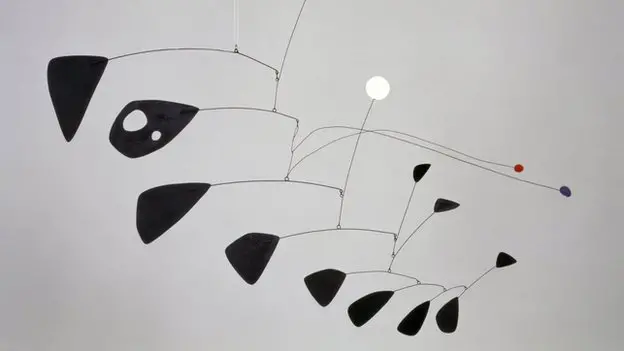
My 3D animations aim to change an object and theme into a planetary setting or vice versa, this will involve planets, stars and space. My goal is to make the transition as seamlessly as I can with my newfound skills in Blender as that’s my chosen platform to create this 3D animation. I want it to flow nicely into one another through the motion of spinning. To do this I researched different scene transitions that are used in animations and the one I’m going to replicate is called morphing at max speed. With this technique, I can take advantage of the spinning animation to create my transition by making my object spin quicker until it morphs into another. For the planets I want to make
Keeping the spinning idea in mind, I came up with a few ideas of spherical objects changing into a planetary theme based on music. I chose to do a disco ball to morph into a planet, as the dark setting of a dancefloor and atmosphere, the lights and the sphere shape of the disco ball would be perfect to change into a planetary theme. I do plan on adding planets and rings around the main planet to add more depth and movement into the animations once the morphing portion is executed but I’ll have to see if I have enough time to include those extras. The use of a disco ball hanging from a ceiling relates to Calder’s sculptures, the purpose is to show that motion doesn’t always come from the ground but from the ceiling too. I will add music to my animation to make the link from the disco ball to the planets much clearer. The Natural movement of the planet’s orbits connects directly to Calder’s motion within his artwork. The disco ball moves more mechanically but Calder used to make his artwork move using machinery as well so it will still link well back to the artist.
References
Tim Masters, BBC (2015) Visitors will keep Alexander Calder mobiles on the move at Tate show*. https://www.bbc.co.uk/news/entertainment-arts-33508634 [9/03/25].