The animation will use a classical technique to draw each frame. After some analysis, I realised that the first storyboard I created may be too complex to animate, so I simplified it in my final storyboard.
First Storyboard
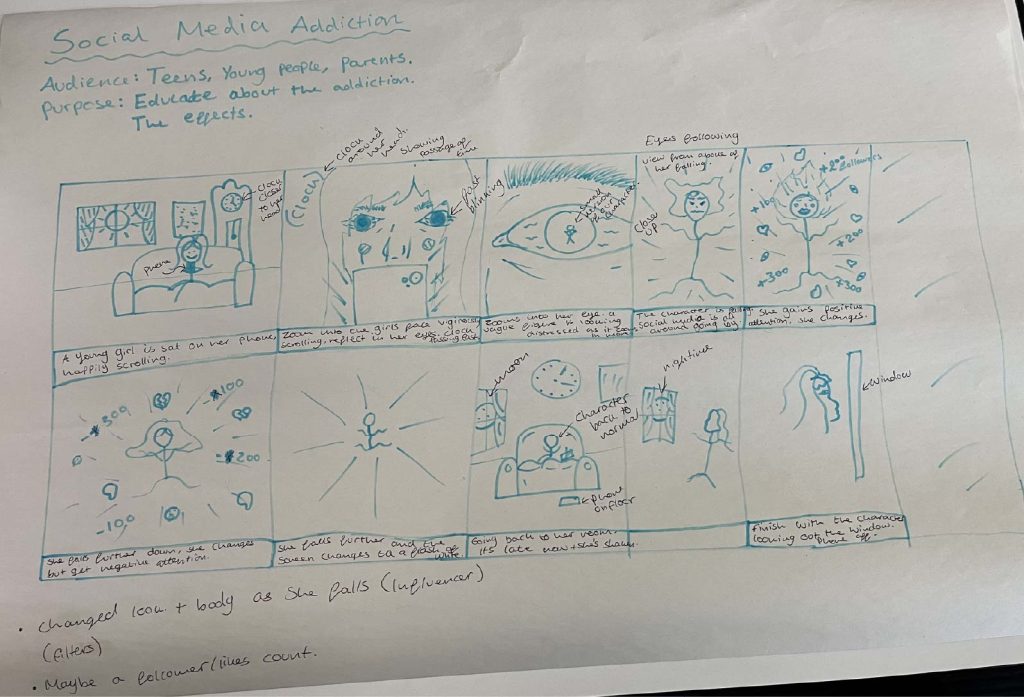
With the theme of social media addiction, the animation follows a character’s journey through their fixation on social media. Showing how it affects their mental health and how they feel as they progress through this addiction. The aim is to educate teens, young people, and parents about how social media can harm their minds and thoughts without realising it. To portray the dread and anxiety of fixating on social media to the audience.
The story begins with a character (a young woman) sitting in contempt, scrolling on her phone. The background conveys a living room with a window behind her, showing the viewer that it is daytime. Adding a clock to the scene further drives the idea of time passing quickly, which will occur throughout the animation. Zooming in, we see the intense stare of the character as she scrolls through social media, her eyes bloodshot. The clock behind her ticks away quicker and quicker, and she spends hours gazing at her phone. Zooming into the eye, we see a small figure representing the character; they look trapped and begin to fall into the addiction to social media.
The scene completely shifts to darkness as the character falls; she enjoys the attention of social media until it starts to get ugly and changes her physically. This is shown by adding social media posts, likes, dislikes, numbers of her follower count, etc. Alongside the character as she falls. The further she goes, the more she changes into a different person, including eyes following her through this falling scene to emphasise that feeling of always being watched. At the end of the falling scene, the character will fall even further into blackness. She appears back on her couch.
Now, the character is in the same scene as the beginning, but the windows showcase nighttime, letting the viewer know how much time has passed, emphasising the idea of wasted time on social media. She drops her phone, fed up with it all, and walks towards her window. She gazes out of it, realising how life is much more than what’s on your phone.
Final Storyboard
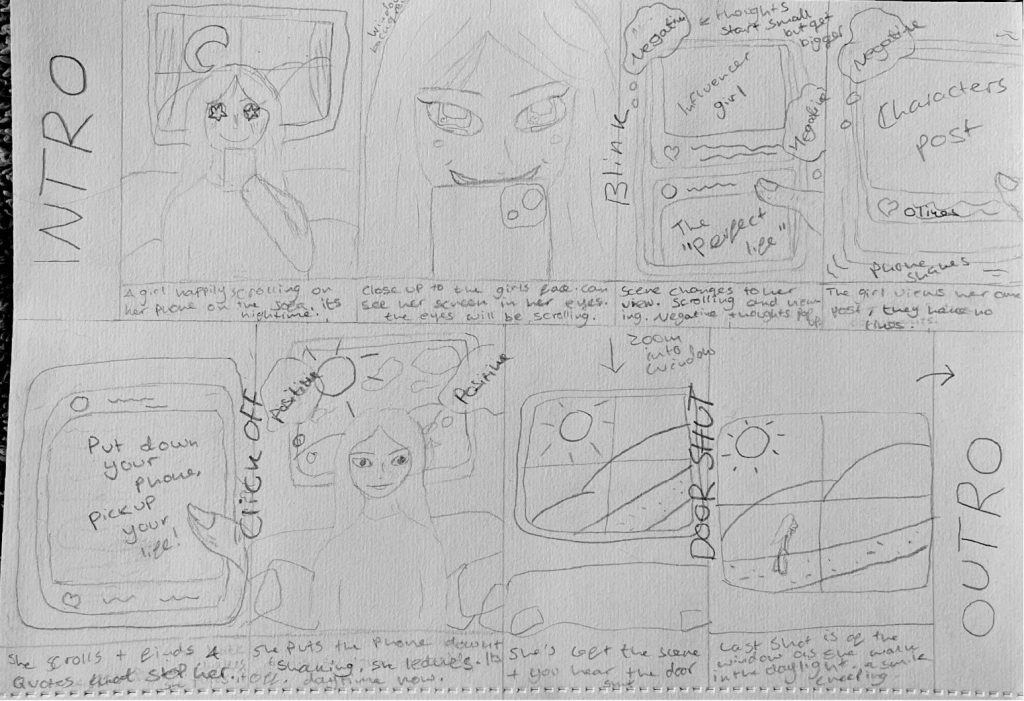
For my refined storyboard, I kept the beginning scene identical but changed the middle and end. I’ve included an intro and outro for the animation.
The first panel will be the intro, which will be simple with the story title. It easily fades into the second panel, which starts the story. In this storyboard, to make it obvious how enamoured the character is with their phone, their eyes are glazed over, staring. The setting is the same as the first storyboard. The clock has been removed because two objects were not needed to show the time. The window will keep showcasing its nighttime.
As she scrolls through, the viewers see all the unattainable standards these platforms set up. Negative thoughts will slowly start creeping up in the character’s mind. Text will be added around the phone so the viewer can understand the character’s feelings and emotions better. As she scrolls, one of her posts comes up in panel five; the post has zero likes, she does not feel good enough, and her negative thoughts swell up; the text around the phone increases. Just as she feels her worst, in panel six, a different kind of post crops up, a positive one with the quote, “Put down your phone, pick up your life,” This stops her in her tracks. She turns off the phones.
With the click of her phone, the next panel commences, and the character is still sitting on her sofa with no phone in sight. It is daytime now, as shown by the window. Positive thoughts start nudging through, as displayed around her head. Panel seven shows her leaving the room, and the viewer will hear a door open and then shut close. For the second to last panel, the focus shifts to the window as it slowly zooms into it. The character is walking along the scene outside in the sunshine. As she walks away into the distance, the outro commences. Finishing off this animation with the outro.
Detailed Sketches
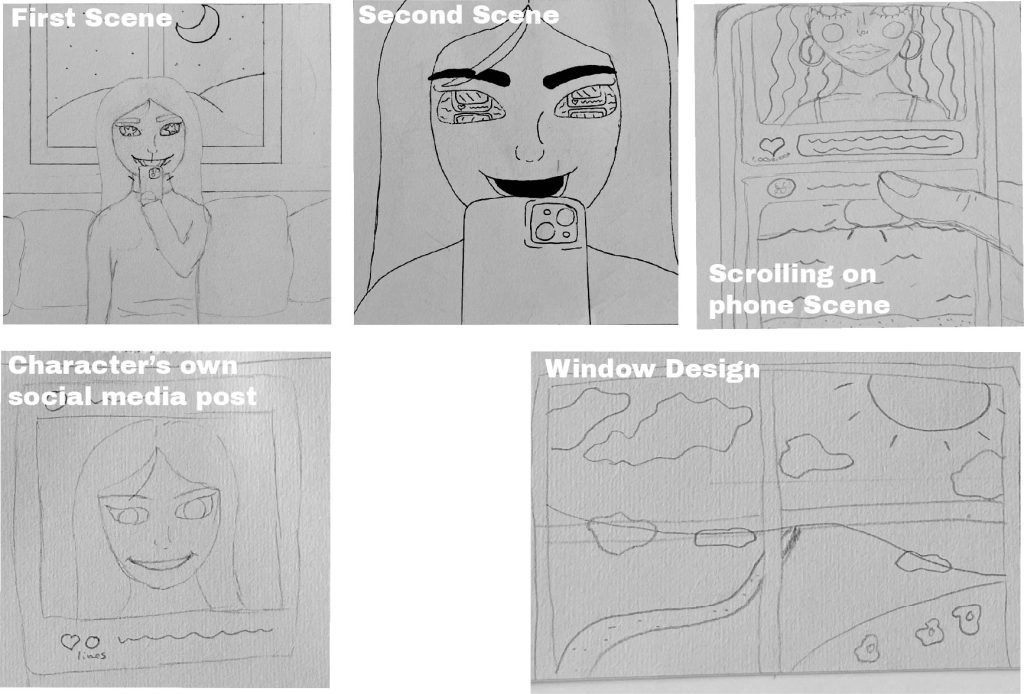
I wanted to challenge myself with classical animation and animate with paper, frame by frame. However, with little equipment to do this, it might be too time-consuming. To avoid wasting paper, which would be over 300 pages, but still wanting to incorporate a hand-drawn style, I invested in a cheap drawing pad to draw straight into Adobe Animate. This will eliminate most of the environmental impact of the animation’s creation.