Foundation Research
To create a compelling and creative VR art exhibition, it is essential to ground the concept in relevant research. When I was proposing the idea of a Kaws exhibition, I wasn’t too sure how I would actually lay out Kaws’ art. I’ve changed the name to exhibition rather than gallery, as I don’t want the VR experience to feel like a traditional art gallery with art pieces on the wall and accompanying information. People can experience that in real life. I aim for the user to experience the art and the emotions it will convey.
Therefore, I explored other VR art exhibitions and galleries via the metaverse store. There are many virtual art galleries; however, I found one that expressed my idea of a new adventure. This experience was called Museum of Other Realities. This game is praised on Metaverse for its magical, otherworldly feel. They support digital artists by paying them to showcase their art in this game, resulting in the use of many different tools, including Gravity Sketch, Substance Painter, and Unity. Users step into paintings as they evolve and take form, experiencing them rather than just viewing them. This helped me greatly with deciding how I want my Kaws exhibition to look. Taking great inspiration from MOR, I now plan to combine Kaw’s most famous work with his iconic colours, shapes, lines, and graphics in a 3D world.
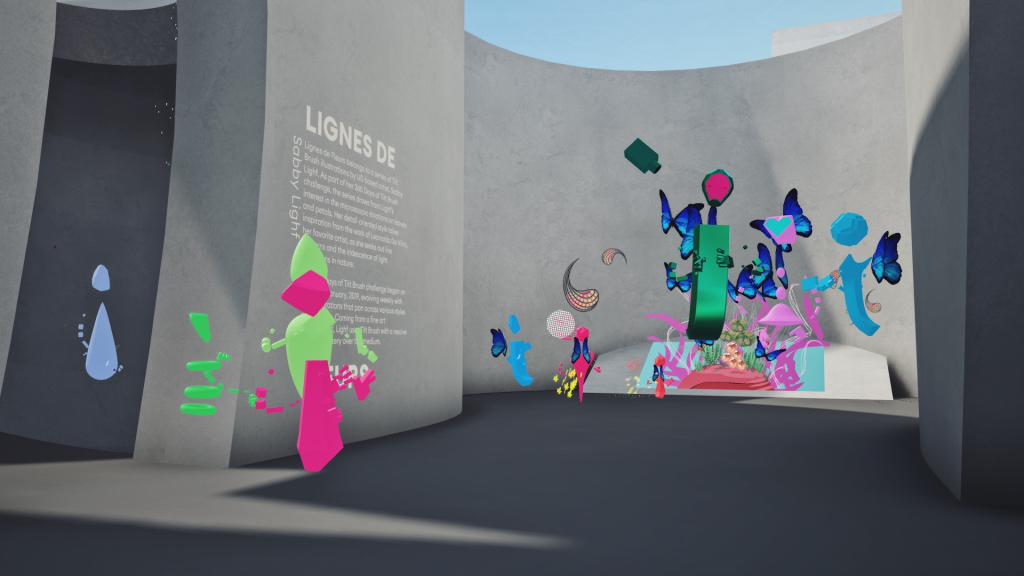
Another aspect of MOR is its use of music and sounds to enhance immersion and emotional impact within its virtual environments. Fabricating a mood that complements the visuals, guiding users, and deepening their presence. To immerse my users in my own art exhibition, I plan to use music to match the artwork’s mood.
Now that I have a clearer understanding of how I will execute the KAWS exhibition within a VR environment, I can conduct in-depth research into KAWS himself. This includes exploring his artistic background, career evolution, and the key themes present in his work. I will also carefully select specific KAWS artworks best suited for adaptation to the virtual space, considering how their scale, color, and form will translate into an immersive VR experience. This research will inform both the conceptual direction and the practical development of the exhibition, ensuring that the final piece accurately represents KAWS’s artistic vision while showcasing the unique possibilities of VR.
Researching Kaw’s art career from the very beginning, I learnt he began as a humble American graffiti artist, using the tag Kaws, his real name being Brian Donnelly. He broke the mold on sculptures, paintings, and limited-edition toys that are vastly popular.
In 1999, Kaws became a freelance artist for Disney, where he found inspiration for his own character, Companion. Donnelly’s most famous character to date. He designed a lot more characters after the companion. An artistic choice of using x’s on these models’ hands, eyes, feet, and ears was added to signify death and add humanity by the use of emotion to these child-like figures. All this information and facts about Kaws will be used in the final piece to guide the users through his art career.
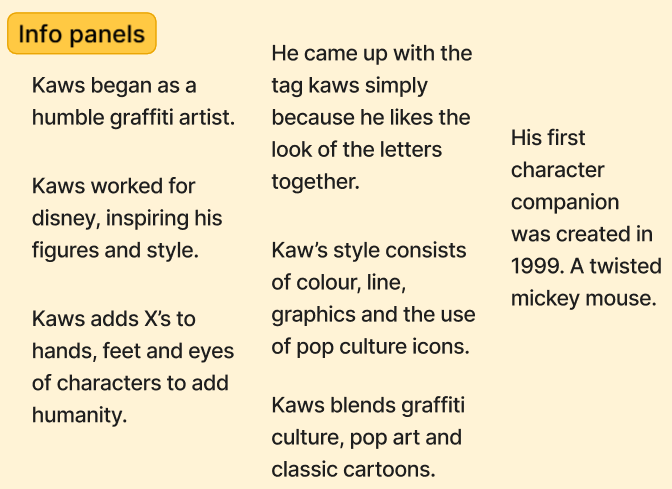
Finally, I’ll be showcasing the art pieces I chose to be involved in the art exhibitions, keeping in mind how they’ll be presented in the virtual space. Most aspects of his paintings and models will be curated in Blender first and designed in Substance Painter and/or Gravity Sketch.
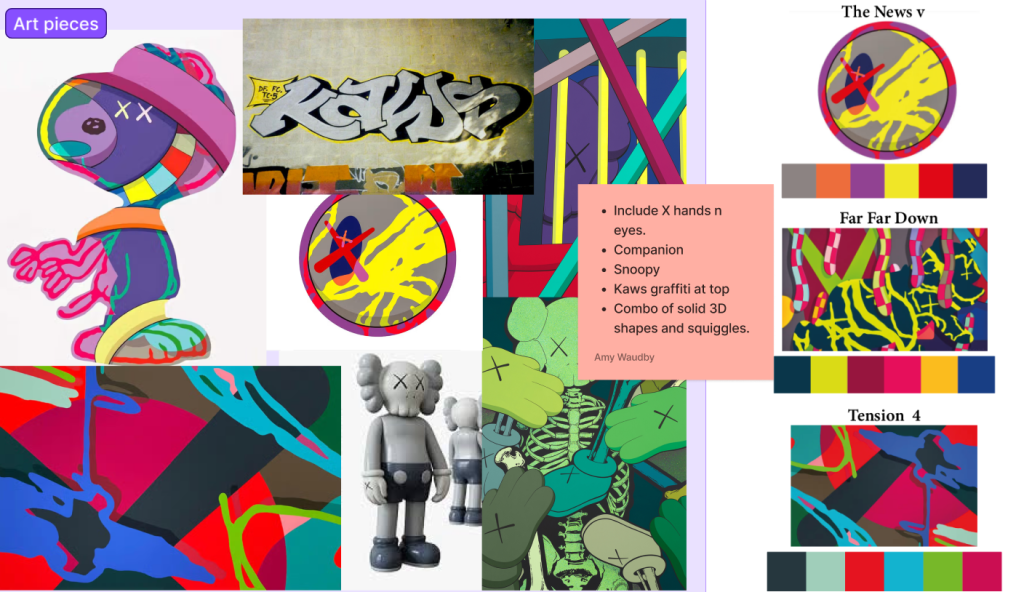
I aim to incorporate at least one of each of Kaw’s most famous artworks, including his character companion, a collaboration with Snoopy, his iconic motifs of the Xs, and his signature use of shapes, line, and colour. This is to make the exhibition instantly recognisable. Deciding on the colour palette is difficult, and I have even been considering using all his colours, depending on the art pieces. I used three of his colourful artworks to create three different colour palettes; however, I will decide what to use when I start designing the final piece.
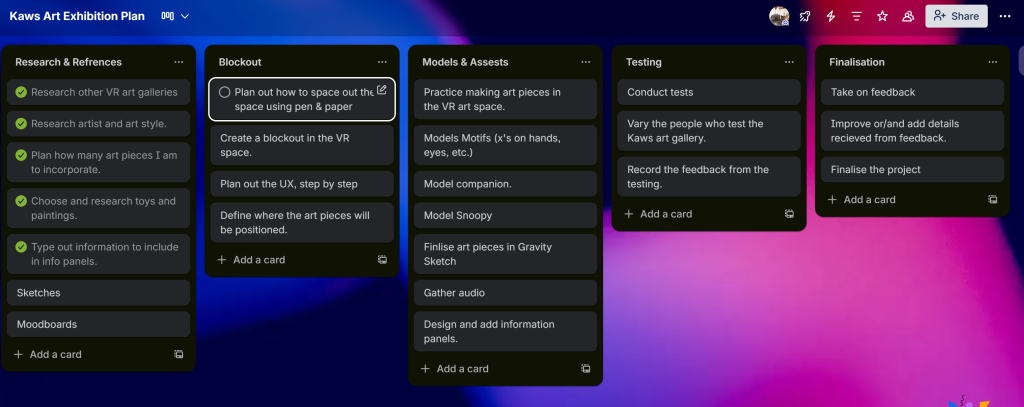
Development
The first obstacle I need to tackle is the layout of the art pieces within the virtual space. I roughly sketched my idea for scale and positioning. I did this from the front and aerial views to better understand the spacing.
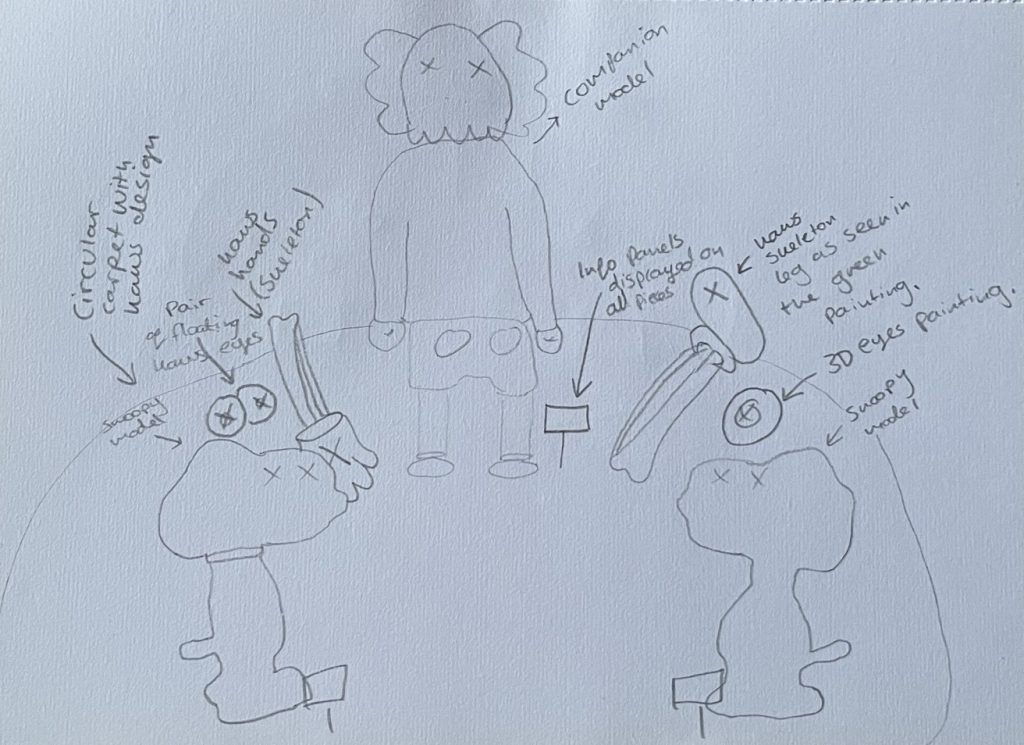
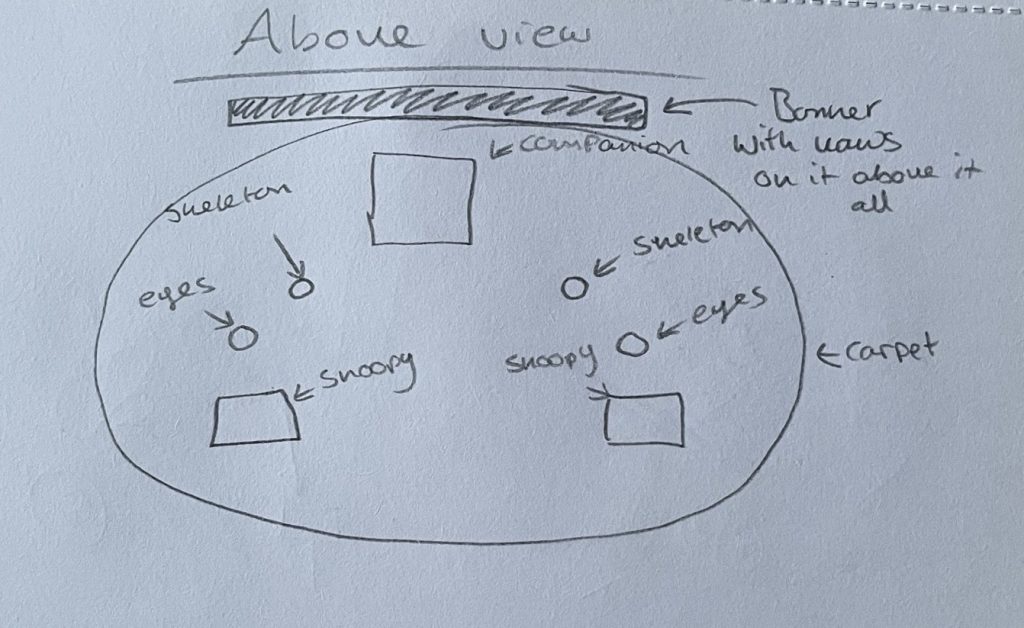
Modelling was next, as I knew this would be time-consuming. After completion, I wanted to waste no time and chose to use models made by someone else on Sketchfab. I ended up just using one model, the Skeleton Companion.
During this phase, I was also learning to use Gravity Sketch and Open Brush to decide which would best suit my project. I was leaning much more towards OpenBrush, as they have amazing tools for fabricating atmospheric environments and offer lots of customisation. I ended up choosing Gravity Sketch in the end, even though it’s primarily used for model design. This was due to the very complex OpenBrush model upload system, which I unfortunately couldn’t figure out. Gravity Sketch was a breeze to upload assets from your laptop. This poses a challenge to me, designing and creating a 3D art piece based on KAWS in Gravity Sketch would limit customisation, so I plan to rely on models to bring my final piece together.
After this realisation, I decided to change my plan to combine multiple Kaws artworks and focus on two artworks I believed would flow perfectly together. Those art pieces are FRACTURE, which was actually designed for a very expensive blanket, and the painting Spoke Too Soon. (image of them). Both these art compositions relate to one another through the use of the same tones and colours, and the subject focuses on the subtle shyness and sadness that occur in KAWS artworks. Doing so will also allow me to be more creative and create an immersive, emotional final design.
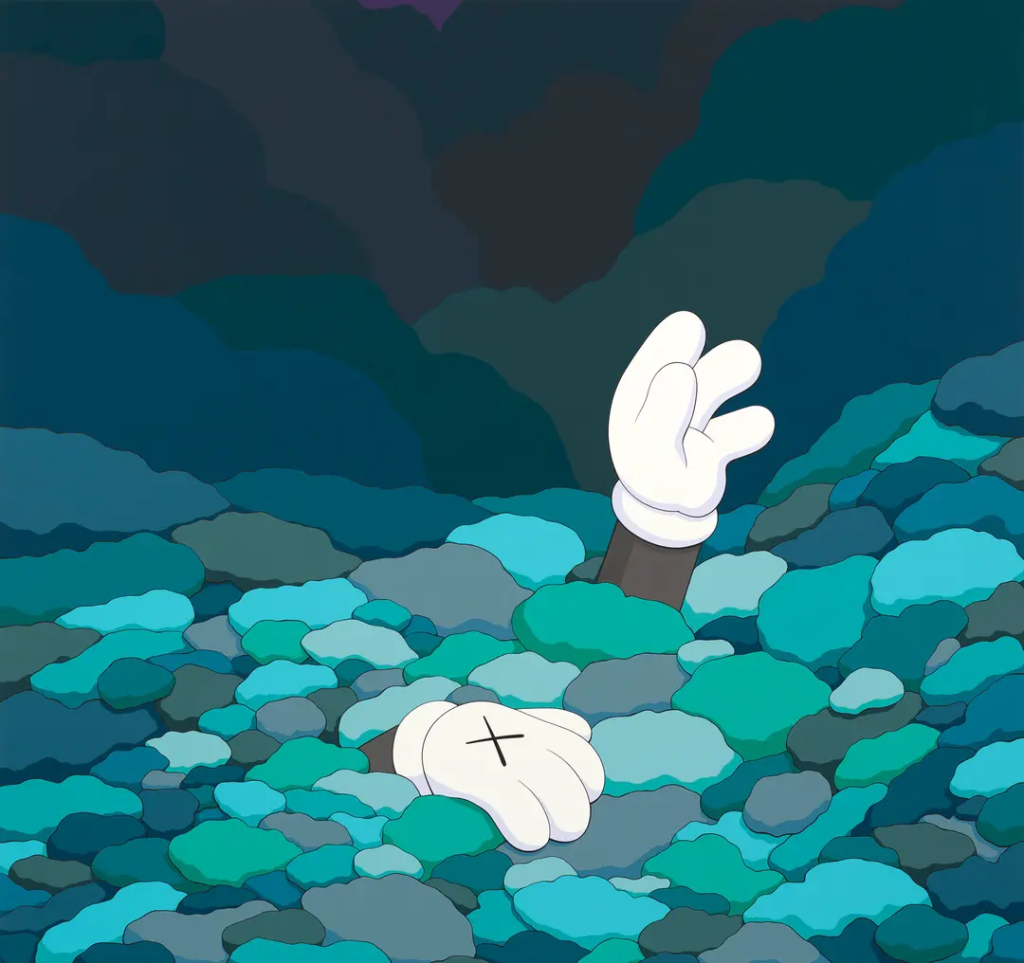
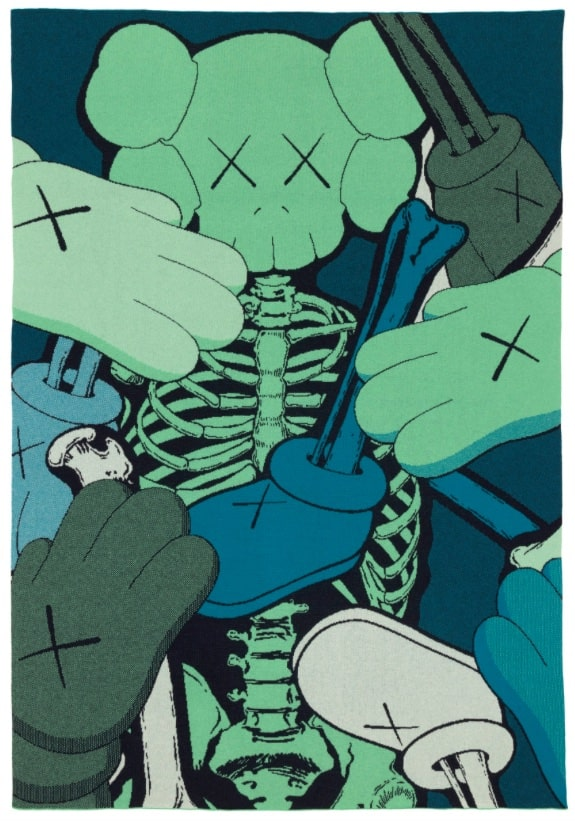
To develop this idea further, I sketched out a new layout on paper. Drawing out a physical sketch of the exhibition space helps me visualise the flow, space, and positioning of key elements. Keeping the 3D aspect in mind while designing the layout. Ensuring the design will be effectively immersive in the VR environment.
After downloading the skeleton companion model from Sketchfab, I opened it in Blender for further preparation. I had to export the model as an OBJ file format, which is compatible with Gravity Sketch. Gravity Sketch has a simple file system: you can log in to your account in a web browser and upload files directly from your computer. These files will appear in the folder in Gravity Sketch linked to your account. Additionally, I broke apart the skeleton’s limbs in Blender and exported each as their own OBJ file. I did so using the edit tool and separating the highlighted area from the model. This step was essential to reconstructing the FRACTION artwork in VR. This allows me to design and manipulate limbs independently in Gravity Sketch, closely mirroring the original artwork.
In Gravity Sketch, I began designing the foundation of the exhibition: the flooring. I uploaded an image of the painting Spoke Too Soon into the workspace so I could use it as a reference and keep the art accurate in style and colouring. Using the volume brush, I fabricated stone-like shapes to replicate the fluffy cloud-like shapes in that painting. The volume brush isn’t the exact shape used in the painting, but it’s the closest I could find, as there was limited customisation. Unfortunately, I couldn’t colour-pick the colours from my reference image for my pebbles, so I tried to match the colouring as best I could. There were styling options for the colours, like flat, reflective, etc. The one I used was called toon, adding a cartoon black line around the shapes, which is very similar to KAWS’s style.
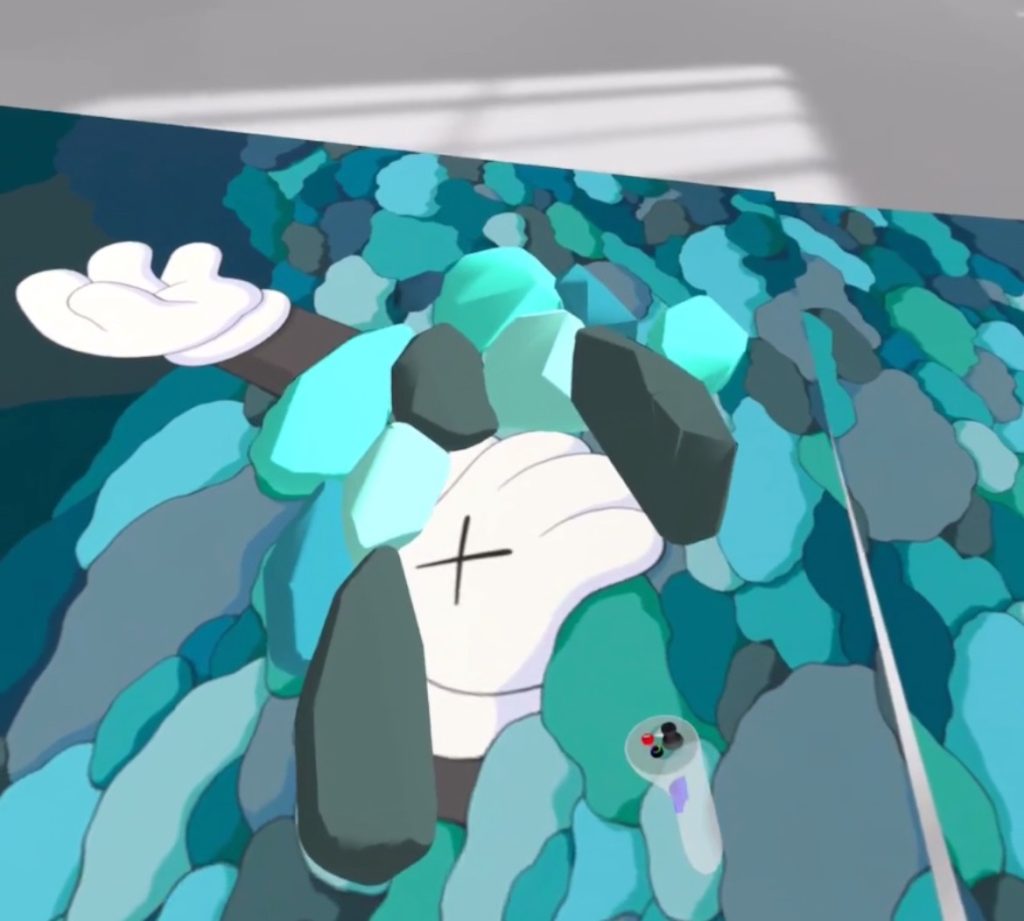
Once I was satisfied with the pebbles, I began duplicating them and combining them to create a larger flooring space. Scaling them much larger to cover the ground. This started to cause problems for Gravity Sketch. I’m not sure whether the sheer number of shapes in the overall floor piece caused this problem, or if other factors did, but it caused the flooring design to randomly shrink and disappear, forcing me to rescale everything and reposition it. I also noticed the levelling was off from the design. With this room file struggling, I decided to restart and create a new room.
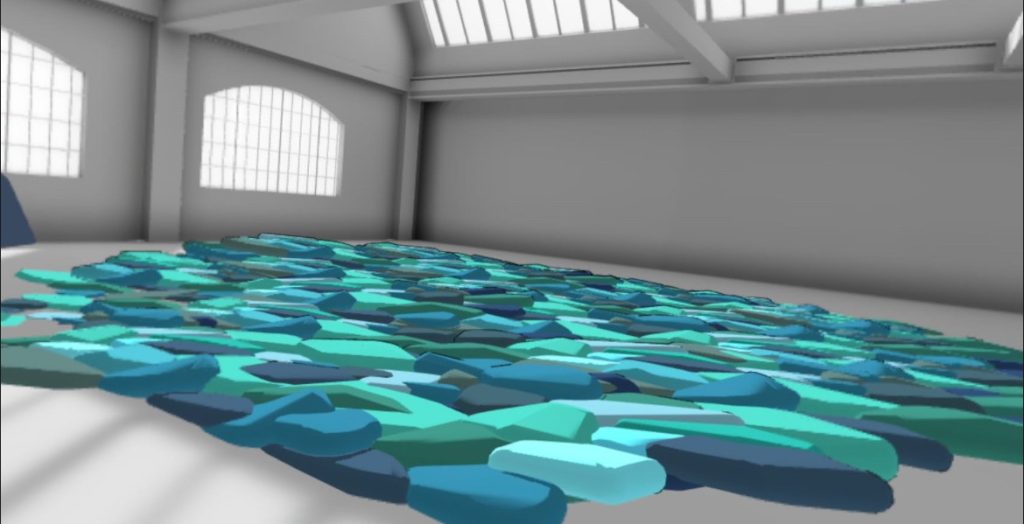
In this room, I learnt I could customise the background to a degree, so I changed the colouring to match the combination of the two art pieces, picking a dark blue to create a sombre atmosphere. This time, I started with the main asset, adding all the models. In total, there were 4 models: the skeleton companion, his arms, legs and head. Like before, I imported a reference image of the FRACTURE artwork to match the style and colouring to the 3D rendition. For each model, I coloured them in the order of the original artwork, in the toon style, and positioned all the objects to create a 3D walkthrough of the composition. This causes some models to float and protrude from the flooring.
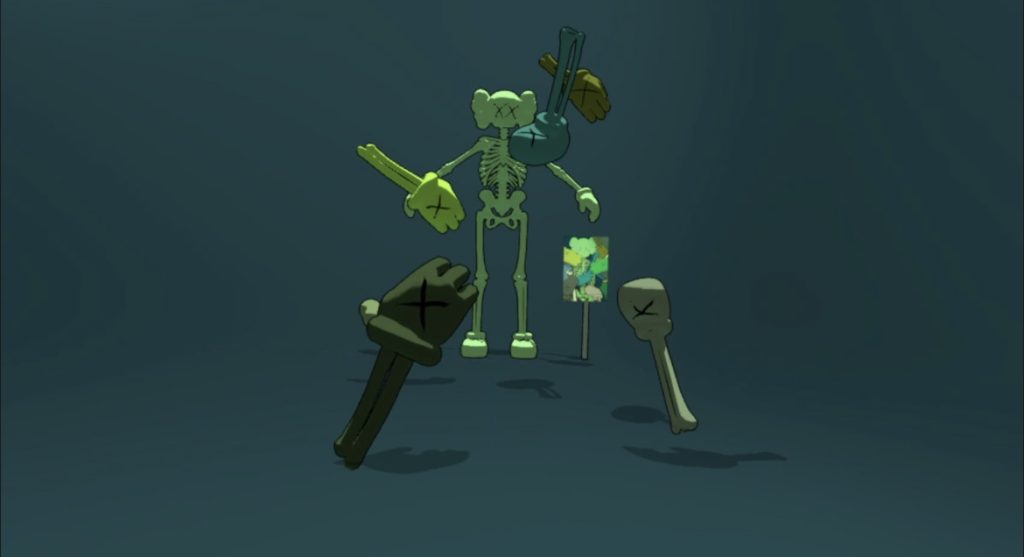
To assist with accurate scaling and spatial composition, I marked an X on the ground in the virtual environment to designate the initial viewing position for users. This reference point allowed me to consistently assess the scene from the intended perspective—several feet away from the artwork—ensuring that the proportions and placement of the legs and hands appeared coherent and impactful. By repeatedly checking the composition from a fixed spot, I was able to fine-tune the positioning of each element so that the arrangement would make visual sense.
Once I was happy with the models’ spacing and positioning, I started designing the flooring again. This time, I planned to curate it piece by piece to avoid confusing the system. However, to make it coherent with the green hues used in the skeleton portion of the final work, I slightly adjusted the colouring to blend seamlessly with the rest of the exhibition. Still involving the blues colouring, as Kaws used a varied colour palette in his work. I used the same technique before and began breaking the pebbles apart to merge them better.
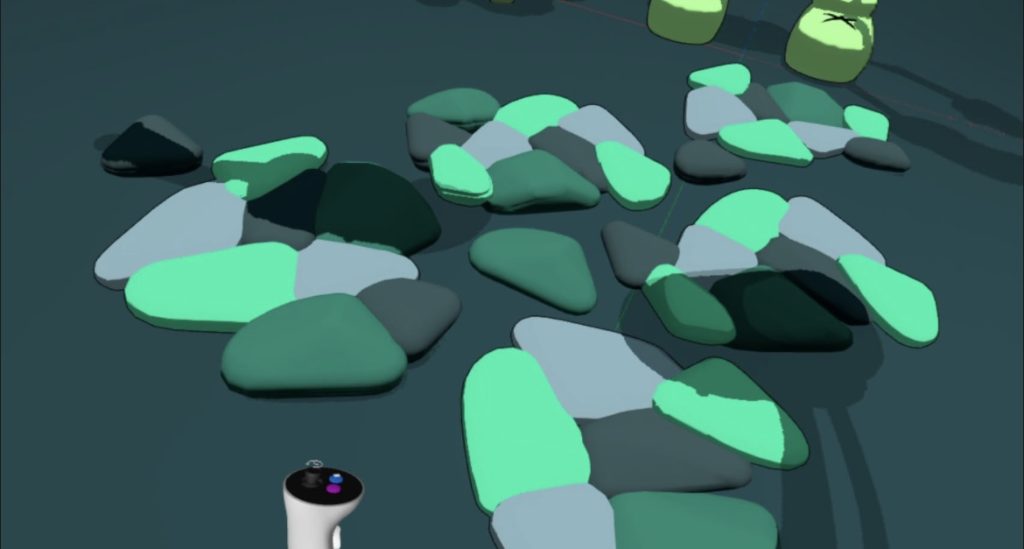
Expanding on the pebbles, I fabricated the flooring to bring the final pieces together. Making it seem to scale and not float in mid-air. I added a varied amount of pebbles, spreading them out.
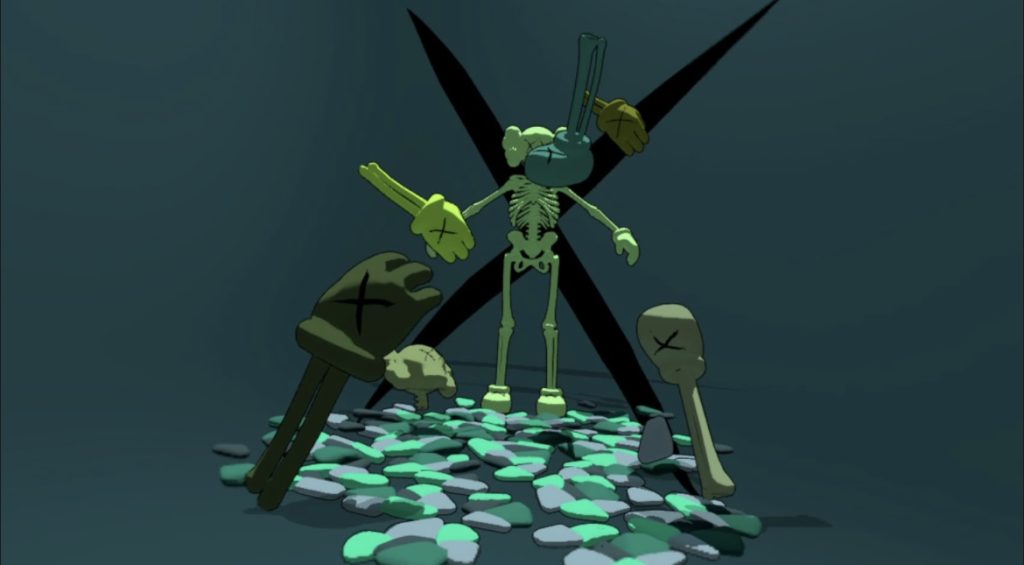
The final piece above won’t be identical to that in the final video. I removed the X in the background because I felt it was too much contrast with the rest of the colours, and I added the random Kaws facts I planned to incorporate to make the experience more interactive and interesting.
The Un-narrated Video
Portfolio Video
References
Jason Rosenfeld (2021-2022) KAWS: SPOKE TOO SOON [Blog post]. Brooklyn Rail. Dec/Jan. https://brooklynrail.org/2021/12/artseen/KAWS-SPOKE-TOO-SOON/ [12/01/26].
NA (2024) KAWS – FRACTURE [Blog post]. New Art Edition. 11 November. https://www.newarteditions.com/kaws-fracture/[12/01/26].
Sketchfab (2025) Kaws*. https://sketchfab.com/3d-models/kaws-54fd82a60e3d4e0cad69fb0455d02607 [13/01/26].